

Foam Terrestrial Flies: How to Fish Hoppers, Ants and Crickets With Confidence
There is a point in every season when fish stop looking down and start looking up — not for mayflies drifting in orderly ranks, but for accidents.
A grasshopper misjudges a leap from the bank grass. Ants get shaken off an overhanging branch by the wind. A cricket tumbles down a steep bank and lands in the surface film with its legs still working. None of these insects belong in the water, and that is precisely why fish respond to them the way they do. A terrestrial in the drift is a large, high-calorie meal that cannot swim away and will not be there again in thirty seconds. Stream ecology research has shown that insects falling from bankside vegetation can make up a substantial share of what stream fish eat during the warmer months.
Foam terrestrial flies are how you take advantage of that, and they are far more versatile than their reputation as summer hopper flies suggests. This guide covers when and where to fish them, which species eat them, how to present them properly, and the specific errors that cost anglers fish — for everyone from a first-season angler to a working guide.
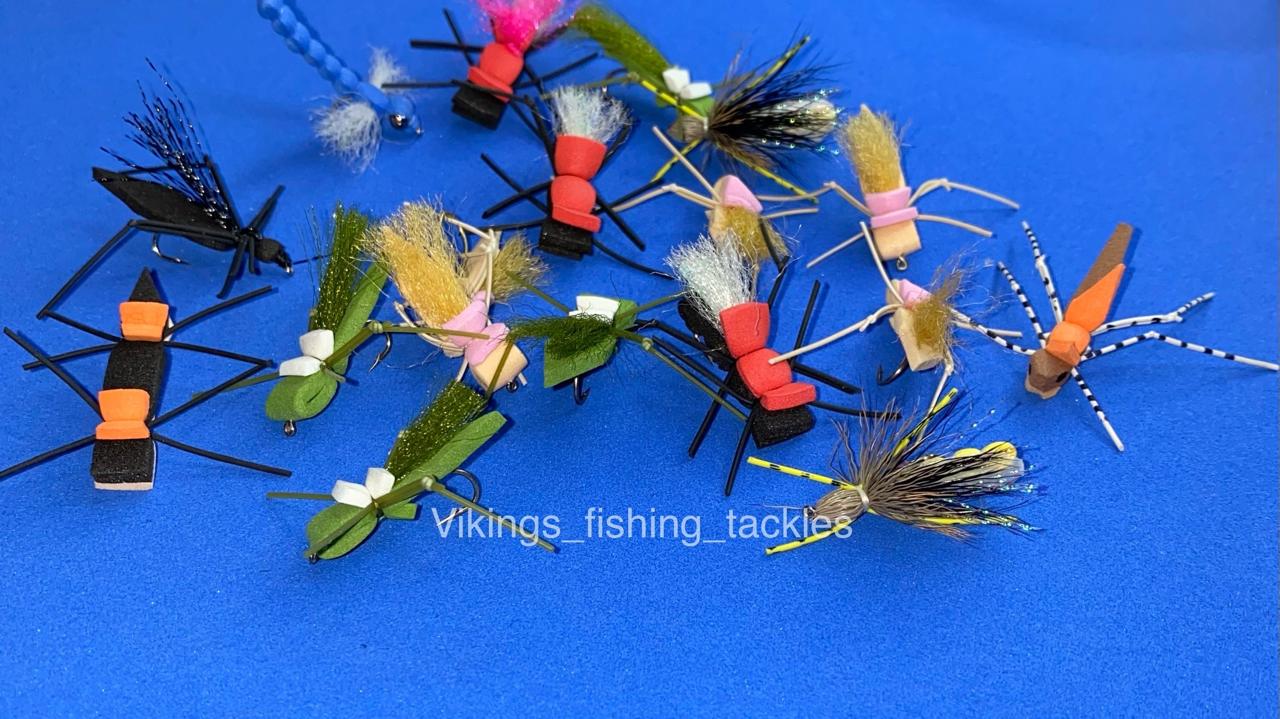
What Makes a Foam Terrestrial Different
Foam Does the Floating
A classic dry fly floats on hackle and surface tension. It is delicate, it demands a clean presentation, and it eventually waterlogs and sinks. A foam fly floats because closed-cell foam does not absorb water at all.
That single difference changes everything else. Foam patterns stay up in riffles, seams and wind chop where a hackled dry would drown. They keep floating after being chewed, they can carry a nymph suspended beneath them, and they can be tied far larger than a conventional dry without becoming unfishable — which matters, because an adult grasshopper is a big insect.
Rubber Legs Do the Convincing
The barred and solid rubber legs on patterns such as the Form Hopper and the Chernobyl Ant are not decoration. They are the working part of the fly.
In current those legs pulse and tremble constantly, and after you twitch the fly and stop, they keep moving for a beat or two after the body has settled. That residual motion is very often what turns a fish that has risen to inspect into a fish that commits.
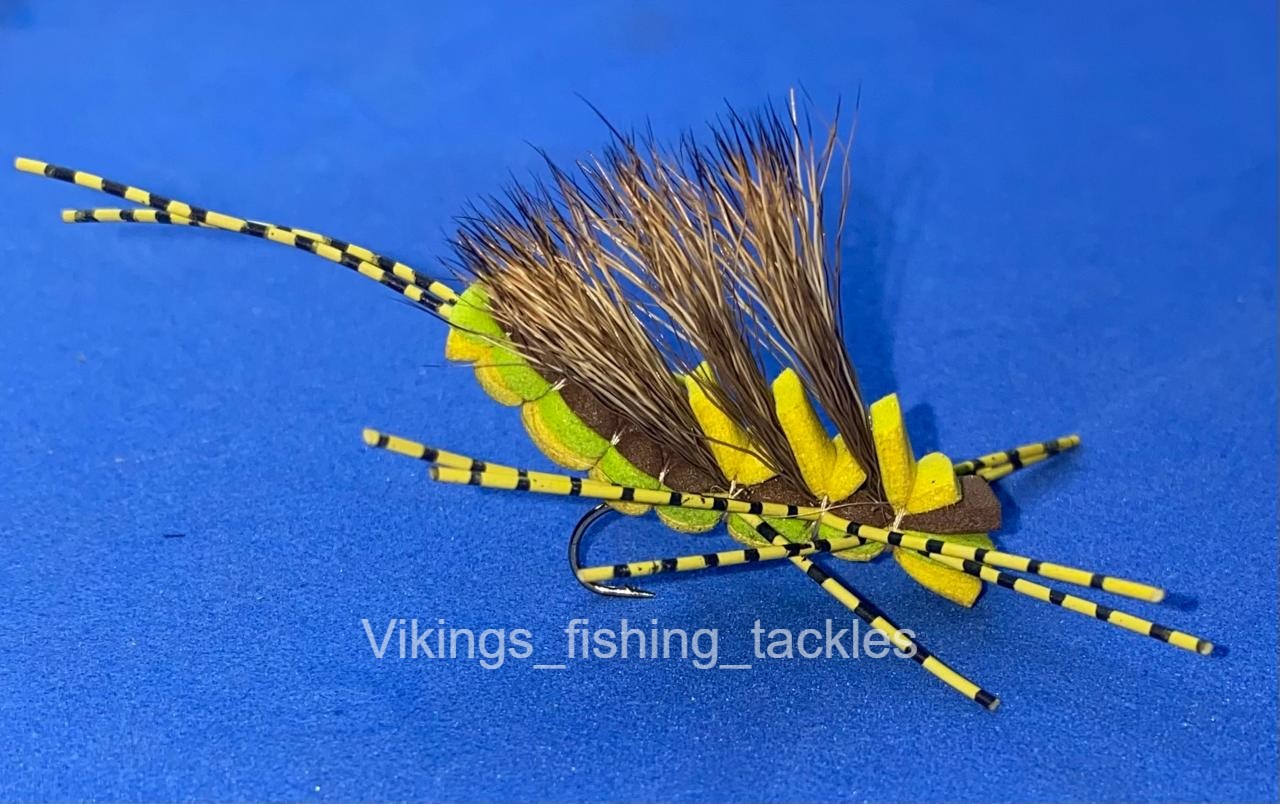
The hopper above shows how those parts stack up. A dark foam base carries the hook and keeps the fly sitting level, a brighter over-layer adds buoyancy and a flash of colour that fish read from below, and a natural deer-hair wing breaks up the outline from above. The barred legs are splayed wide enough to leave separate prints in the surface film. Other patterns in our Terrestrials collection reach the same result by different routes — the Form Grasshopper (triple decker) stacks its foam in visible layers instead of hiding the bulk under hair, and the Chubby Chernobyl (tan) replaces the deer hair with a synthetic wing that stays visible longer in glare.
The Wing Post Is for You, Not the Fish
Many of these patterns carry a bright synthetic wing or a small foam tab in white, pink, chartreuse or orange. The Fat Albert Hi-vis is built around exactly this idea.
The fish does not see that colour. From below it registers a dark body outline, the dent the fly makes in the film, and legs breaking through. The bright post exists so you can track a small fly at forty feet in glare or fading light — the difference between detecting a soft take and staring hopefully at a patch of water.
When to Fish Foam Terrestrials
Time of Year
Terrestrial fishing follows insect life cycles on land, not in the water. Grasshoppers, crickets, ants and beetles need warmth to reach adult size, so the window opens as warm, dry weather sets in and closes with the first genuinely cold nights.
The peak arrives later than most anglers assume. Early-season hoppers are small and sparse; late-season hoppers are large, clumsy and everywhere. Late in the season, size up rather than down.
Time of Day
This is the reverse of classic hatch fishing. Terrestrials favour the middle of the day — roughly late morning through mid-afternoon — because that is when insects are warm, active and therefore making mistakes. If you have ever wondered what to do during the flat, bright hours when nothing is hatching, a hopper fished tight to the bank is one of the few reliable answers.
Why Wind Helps
Most anglers curse wind; in terrestrial fishing it works for you. A breeze crossing a grassy bank and pushing onto the water physically delivers insects to the fish, and the fish learn to expect it. Find a bank the wind is blowing off and fish it hard. The chop also disguises your leader and forgives a heavier landing.
Where to Fish Them
Terrestrial fishing is edge fishing, and this is the single most important thing to understand about it. A hopper does not fall in the middle of the river — it falls within a foot or two of where it was sitting. A Morris hopper landed a hand’s width from the grass will consistently out-fish the same fly two metres out.
- Undercut banks with overhanging grass or reeds.
- Deep water pressed hard against a steep edge.
- The shade line beneath trees and bushes.
- Current seams where bank flow meets the main flow.
- Bays and eddies where wind funnels floating debris.
Slow, dark water tight against a grassy bank is prime territory, particularly on the calmer stretches covered in our guide to fishing streams and slow-moving waters.
Species That Take Terrestrials
Trout. The classic target. Rainbow and brown trout in cool, clear rivers and spring-fed streams feed heavily on terrestrials through the warmer months, and on grassy-banked water they will often take a hopper in preference to anything hatching. Match your fly size to the naturals you can flush out of the bank vegetation.
Bass. Largemouth in warm dams and lakes take large foam patterns aggressively, and they respond to surface disturbance in a way trout do not. Anglers targeting bass should also look at our Bass Bugs, though a large Fat Albert pulled along a weed edge draws savage takes.
Yellowfish, carp, barbel and chub. All eat terrestrials opportunistically. Carp especially can be sight-fished with a foam beetle or ant in calm margins — technical, rewarding fishing.
Panfish and smaller species. Abundant, willing and forgiving of imperfect presentation. Ideal for building terrestrial technique before taking it to harder fish.
How to Fish Foam Terrestrials Effectively
Land It Like It Fell
A real hopper hits the water with an audible plop. This is the one situation in dry fly fishing where a slightly firm landing helps rather than hurts. Aim so the fly arrives at the bank rather than beyond it, and accept a small splash — that sound is a feeding trigger, and many fish turn towards a hopper before they have properly seen it.
Dead Drift First, Twitch Second
Start with a completely natural drift and no added movement. Most takes come on a clean dead drift.
If a drift comes through untouched, add a single small twitch — a few centimetres, made by lifting the rod tip rather than stripping line — then stop and let it drift again. That stop is critical: the legs are still working while the body sits still, and that is frequently the moment of the take. Cover water methodically, two or three good drifts per likely bank, then move on.
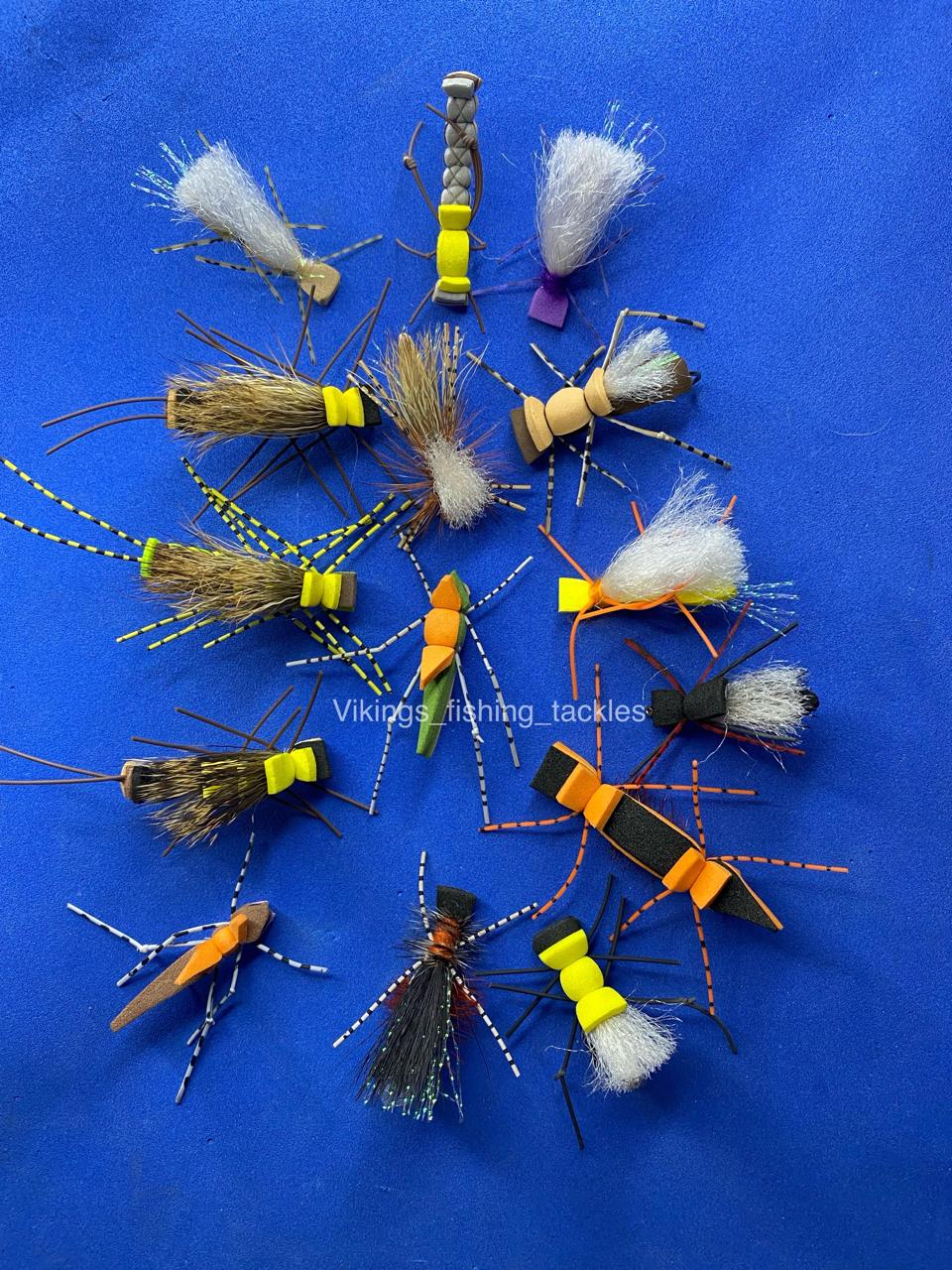
The Hopper-Dropper Rig
The most efficient rig in freshwater fly fishing is a buoyant foam terrestrial with a nymph suspended beneath it. Tie 45 to 90 centimetres of tippet to the hook bend or to a small ring behind the foam body and hang a weighted nymph from it. You are now fishing two food levels at once, and the terrestrial doubles as a highly visible indicator that is itself a legitimate fly.
The Chubby Chernobyl (tan) and the Fat Albert suspend a nymph well thanks to their foam volume. Pair one with a bead-head from our Nymphs range and start with the dropper shallow. Fish will tell you quickly which of the two they want.
Leader, Tippet and Casting
Foam terrestrials are bulky and wind-resistant, so use a shorter, stouter leader than you would for delicate dry fly work — roughly 2.7 to 3.6 metres with tippet in the 3X to 5X bracket. Open your casting loop slightly, too; a tight, high-line-speed loop is exactly wrong for a fly with this much air resistance and will cause tangles.
Setting the Hook
The most common error in terrestrial fishing is striking too early. These flies draw confident, visible, sometimes theatrical rises, and the sight of it makes anglers snatch the fly straight out of the fish’s mouth. Wait until the fly has disappeared and the fish has turned down, then set with a firm, low sweep to the side rather than a sharp lift.
Five Mistakes That Cost Beginners Fish
1. Fishing too far from the bank. The fish eating terrestrials are in the last metre against the grass. Get uncomfortably close to the edge.
2. Adding too much movement. Constant twitching reads as unnatural. A real hopper struggles in bursts and then goes still.
3. Striking on sight. Let the fly vanish before you set. Patience converts more rises than any change of pattern.
4. Fishing too small. Flush the bank grass, look at what flies out, and match it — which frequently means a bigger fly than feels comfortable.
5. Ignoring wind direction. A bank with the wind blowing off it is a feeding station. Two minutes of observation before your first cast will change your day.
Refinements for Experienced Anglers
Read the bank before the water. Walk a stretch and disturb the grass. If it erupts with insects, that bank deserves attention. If it is quiet, so are the fish. This habit separates anglers who happen to catch on hoppers from anglers who fish them deliberately.
Vary silhouette, not just colour. The common refinement mistake is cycling through colours when the real variable is profile. A slim Form Cricket and a bulky Form Grasshopper (triple decker) present entirely different shapes from below. On pressured water, switching to a slimmer silhouette often produces where colour changes do not.
Use the fly to prospect. A foam terrestrial worked along an unfamiliar bank reveals fish you did not know were there. Even refusals are information — a fish that rises and turns away has given you its exact position.
Fish them outside the obvious season. Ants and beetles stay active well beyond peak hopper time, and a small foam ant on a cool, bright day can outperform anything else in the box.
Mind water temperature. In hot conditions fish recover poorly from being played. Fish early, keep fights short, keep the fish wet, and move to cooler water as the day heats up. Trout Unlimited publishes sound practical guidance on warm-water handling.
Choosing Terrestrials That Last
Foam terrestrials take more abuse than almost any other fly. They get slammed against banks, dragged through grass, chewed, and asked to hold a nymph without sinking. Construction quality shows quickly: legs pull out, foam separates from the shank, and a fly that looked fine in the box stops floating level.
Our terrestrial patterns are tied entirely by hand, with more than thirteen years of tying behind every pattern we produce. Working at the vice gives our tyers control over proportion, material placement and finish — and that control decides whether a foam hopper still floats level after its tenth fish. We choose components for how they behave once wet rather than how they look in a bin. You can read more on our About page.
Palmered patterns show this most clearly. On a fly such as the Form Woolly Worm (red), the hackle is wound the full length of the shank and locked down as it goes, so a chewed fly cannot unravel from a single pulled fibre. It is an unglamorous detail that decides how many fish a pattern stays fishable for.
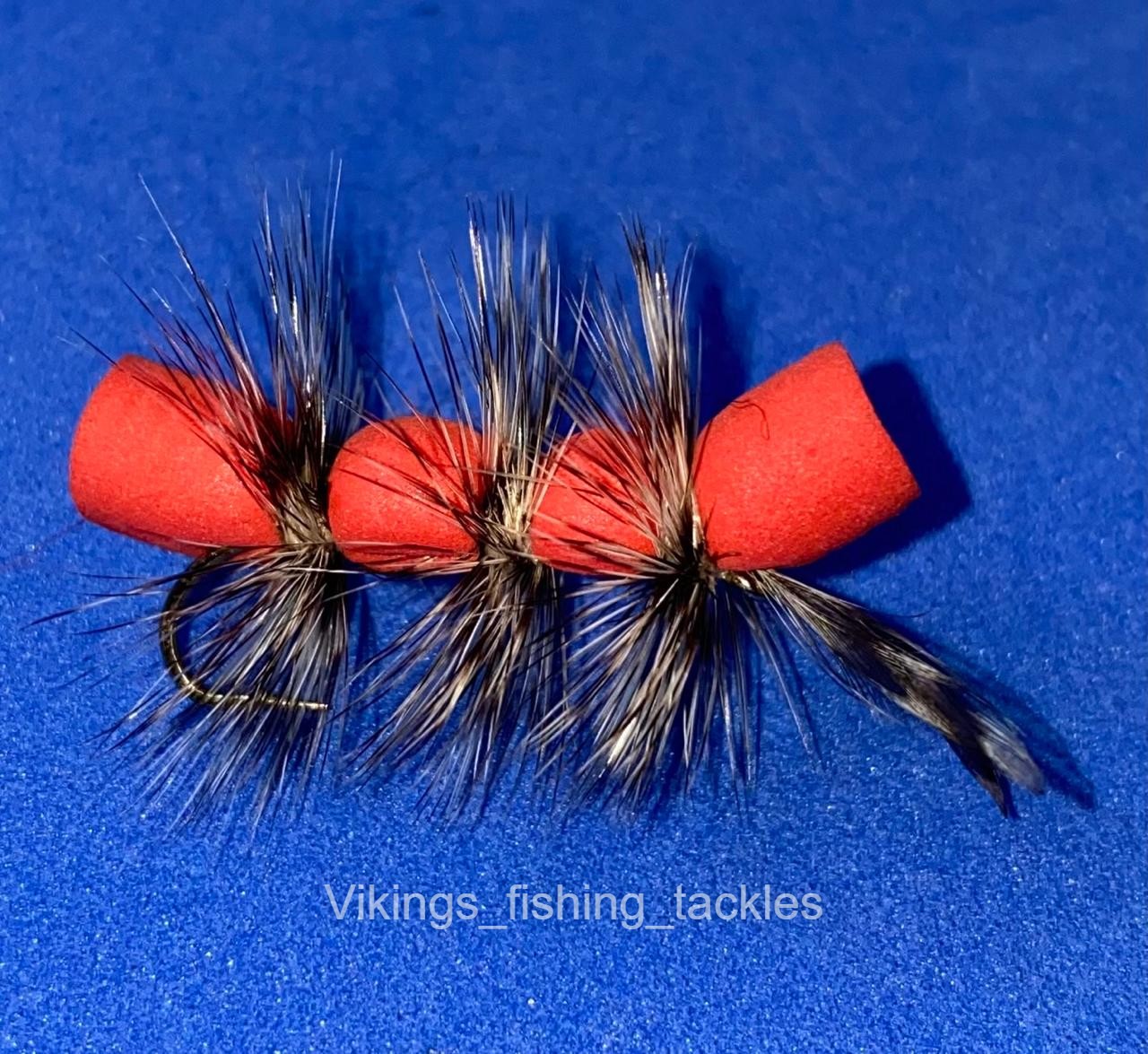
Hackled foam patterns like these also fish differently from a flat foam slab. Because the hackle is wound the full length of the body, the fly dimples the surface along its whole footprint instead of only at the head, which reads softer to a fish holding in smooth water. They are worth reaching for on glassy glides where hard-edged foam draws refusals, and they skate convincingly on a short downstream swing.
Frequently Asked Questions
What size hopper fly should I use?
Match the naturals. Walk the bank, disturb the grass and look at what flies out. Early in the season that often means a smaller fly; by late season the naturals are large and a bigger pattern is usually correct. When unsure, start larger and drop down if fish refuse.
Do foam terrestrials work when there are no grasshoppers around?
Yes. Patterns like the Chernobyl Ant and Fat Albert are attractors rather than literal imitations. They present a large dark profile with plenty of leg movement, and fish take them opportunistically even with no naturals on the water. They are among the best searching flies available.
What is the difference between a Chernobyl Ant and a Chubby Chernobyl?
Both use stacked foam bodies and rubber legs. The Chubby Chernobyl adds a prominent synthetic wing, which increases buoyancy and visibility and gives a broader silhouette. The Chernobyl Ant is flatter and darker in profile. In practice the Chubby floats a dropper better and is easier to track; the Chernobyl Ant is the subtler of the two.
Can I fish terrestrials in still water?
Absolutely. On lakes and dams, fish the margins where wind pushes insects against the bank, and be patient — a foam fly sitting motionless in the film for a minute or more is entirely natural. Small twitches at long intervals beat constant movement.
How do I keep a foam fly floating well?
Foam does not absorb water, so the body keeps floating. What sinks is the hackle, deer hair and legs once saturated with slime. Rinse the fly in clean water after a fish, squeeze it in a cloth or amadou patch, and add a little desiccant powder. Avoid heavy gels on synthetic wings, which mat them.
Five Patterns Worth Starting With
If you are building a terrestrial selection from scratch, these five cover the majority of situations you will meet on rivers, streams and warm still water.
- Chernobyl Ant — the essential searching fly. A flat, dark foam profile with busy rubber legs that draws fish when nothing is hatching. Start here if you buy only one terrestrial.
- Chubby Chernobyl (tan) — the best all-round hopper-dropper anchor. Reads as a hopper, a stonefly or a big caddis depending on the water, and the pale wing is easy to track in glare.
- Morris hopper — a deer-hair-bodied hopper with knotted barred legs for a realistic silhouette. Excellent tight against grassy banks in the second half of the season.
- Form Cricket — the slim, dark alternative for pressured water and steep, shaded edges. Often the answer when fish start refusing bulkier foam.
- Fat Albert — the big-water and bass option. Maximum foam volume, maximum disturbance, and enough buoyancy to hold a heavy nymph without sitting low.
Browse the full range in our Terrestrials collection, or pair any of the above with a bead-head from our Nymphs and Dry Flies categories.
Bringing It Together
Foam terrestrials reward observation more than technical casting. Read the bank, work the edges, land the fly like it fell there, drift it honestly, and wait one extra beat before you set the hook. Do those five things and this becomes some of the most consistent and most visual fishing available in fresh water.
Every terrestrial in our range is tied by hand from materials chosen for how they perform once wet, and we supply individual anglers as well as fly shops, distributors, outfitters and guides worldwide. Fly shops, outfitters and guides can find volume terms and custom pattern options on our Wholesale Partnerships page. If you would like help choosing patterns for a specific river, dam or client programme, get in touch with our team — tell us the water and the species, and we will point you to the right flies.